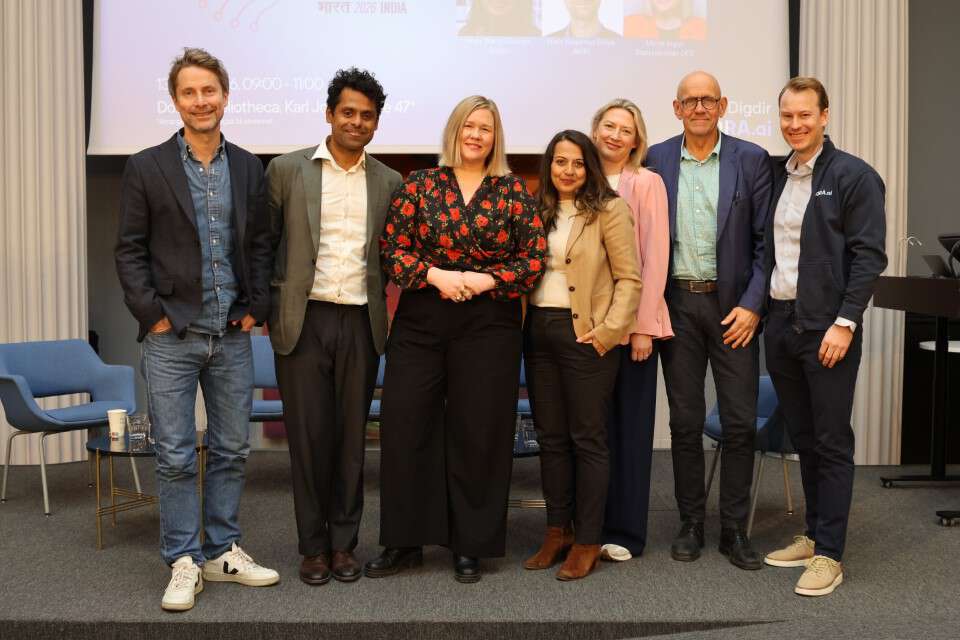
The event followed the AI Impact Summit in India in February, which brought together more than 500,000 participants from over 100 countries. The summit gathered political leaders, industry executives, and researchers to discuss how AI is transforming society—and how it should be governed.
A Norwegian delegation, led by Minister Karianne Tung, took part in the summit. At the Oslo breakfast seminar, Heather Broomfield (KI-Norge), Morten Dæhlen (UiO), Sagar Sen (SINTEF), and Niels Nagelhus Schia (NUPI), who were among the delegates, shared their insights and reflections on what the global developments mean for Norway.
AI, Power, and Democratic Responsibility
A central theme from both the summit and the Oslo seminar was that AI is fundamentally about power. Opening the breakfast seminar, state Secretary Marte Ingul emphasized how technological development is reshaping control over resources, decision-making, and economic value, while also raising concerns about democratic accountability in a landscape dominated by private companies.
Norway faces a dual challenge: accelerating AI adoption while maintaining public oversight. Norway is currently ranked 20th in the world on AI adoption, behind Sweden and Denmark. Ingul pointed to the need for clearer regulatory frameworks and better support mechanisms for organizations deploying AI, in line with the mandate of KI-Norge. She also highlighted the importance of digital sovereignty, framing AI as a matter of national security and strategic control, echoing what Minister Karianne Tung had highlighted during the AI impact summit in India.
Trust and Collaboration in a Fragmented Landscape
High levels of public trust emerged as one of Norway’s strongest assets. Heather Broomfield from KI-Norge highlighted the country’s strong foundations, including trusted institutions, high-quality public data, and a digitally mature population, as key enablers for deploying AI in the public sector.
At the same time, Broomfield raised concerns about whether the global focus on trustworthy AI is sufficiently deep, pointing in particular to gaps in data governance and the need for continued attention to diversity in AI development.
The discussions also reflected a broader shift in the global AI landscape. According to several speakers, including Nagelhus Schia , the conversation has moved from safety to implementation and impact, as reflected in the name of this year’s summit: “AI impact summit” Both Schia and Sen emphasized that collaboration across borders, sectors, and disciplines is becoming essential. For smaller countries like Norway, international partnerships are increasingly seen as a prerequisite for influence. Sen also highlighted India’s growing role as a partner for applied AI, with a strong focus on scaling solutions in practice.
From Hype to Impact—and Sustainability
Several contributors, including Sen, pointed to the need to move beyond hype and focus on real-world applications of AI, particularly in complex, cross-border systems such as energy infrastructure.
Professor Dæhlen f introduced sustainability as a key dimension of the AI debate. He highlighted the environmental costs of large-scale AI systems and raised the question of whether AI can contribute to decoupling economic growth from resource consumption. This, he suggested, could represent an area where Norway takes a leading role.
Dæhlen also pointed to broader concerns about global trust levels and the concentration of power in a small number of actors, reinforcing the need for stronger governance mechanisms, and emphasized the need for a taxation system on data used to train AI models
A Strategic Path Forward
Looking ahead, the seminar pointed to a strategic direction for Norway based on combining national strengths with international engagement. This includes strengthening collaboration, leveraging trust as a competitive advantage, and building closer links between research, policy, and industry.
Broomfield highlighted the role of KI-Norge in developing guidance services, regulatory sandboxes, and national infrastructure, while several speakers stressed the importance of connecting policymaking more closely with research expertise.
In a rapidly evolving global AI landscape, active participation is essential. As emphasized across the seminar, Norway’s ability to shape outcomes will depend on its capacity to engage internationally while building on its domestic strengths.
When summarizing the AI Impact Summit in India, Nagelhus Schia pointed out that the atmosphere there was more that of a local neighborhood bar, only global, and that this global arena functioned more as a platform for fragmented and informal dialogues than an arena for forming binding agreements.
Not long after the Tung delegation attended the Impact Summit in India, NORA CEO Michael Solvang travelled to Canada as part of another Norwegian delegation led by the Minister of Research and Higher Education, Sigrun Aasland. The Oslo breakfast seminar concluded with a brief discussion between Mala Wang-Naveen (DigDir) and Michael Solvang about the Canada visit, which focused more specifically on establishing concrete research collaborations between Norway and Canada in the fields of AI, quantum technologies, and polar research.
Missed out on the seminar? You can watch it on our YouTube-channel.