Opening, Keynotes and Talks on the first day
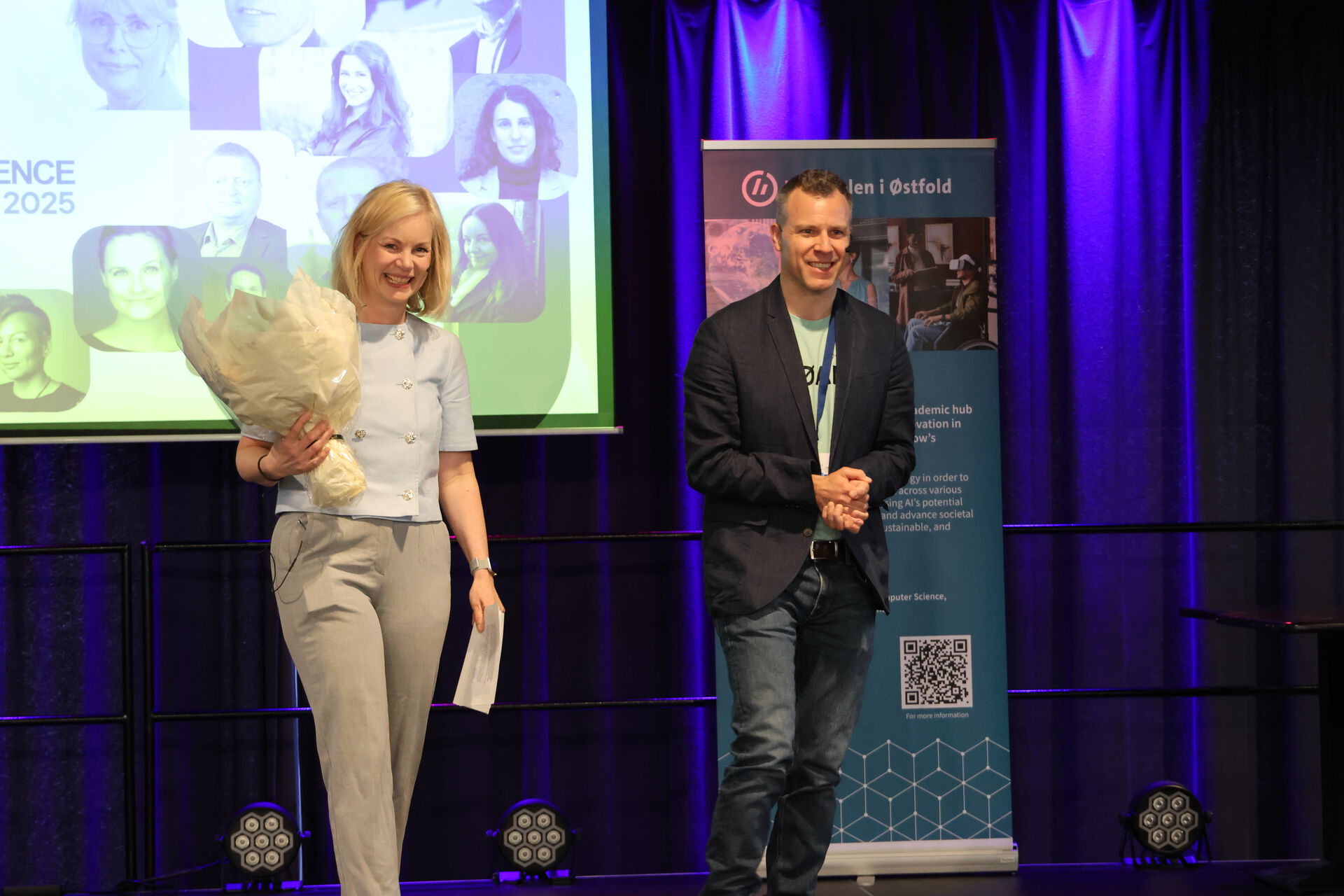
The conference opened with a warm welcome from Prof. Lars-Petter Jelsness-Jørgensen, Rector of Østfold University College, followed by an official address from Sigrun Aasland, Norway’s Minister of Research and Higher Education. Klas Pettersen, CEO of NORA, provided an overview of NORA’s recent initiatives and vision for the future.
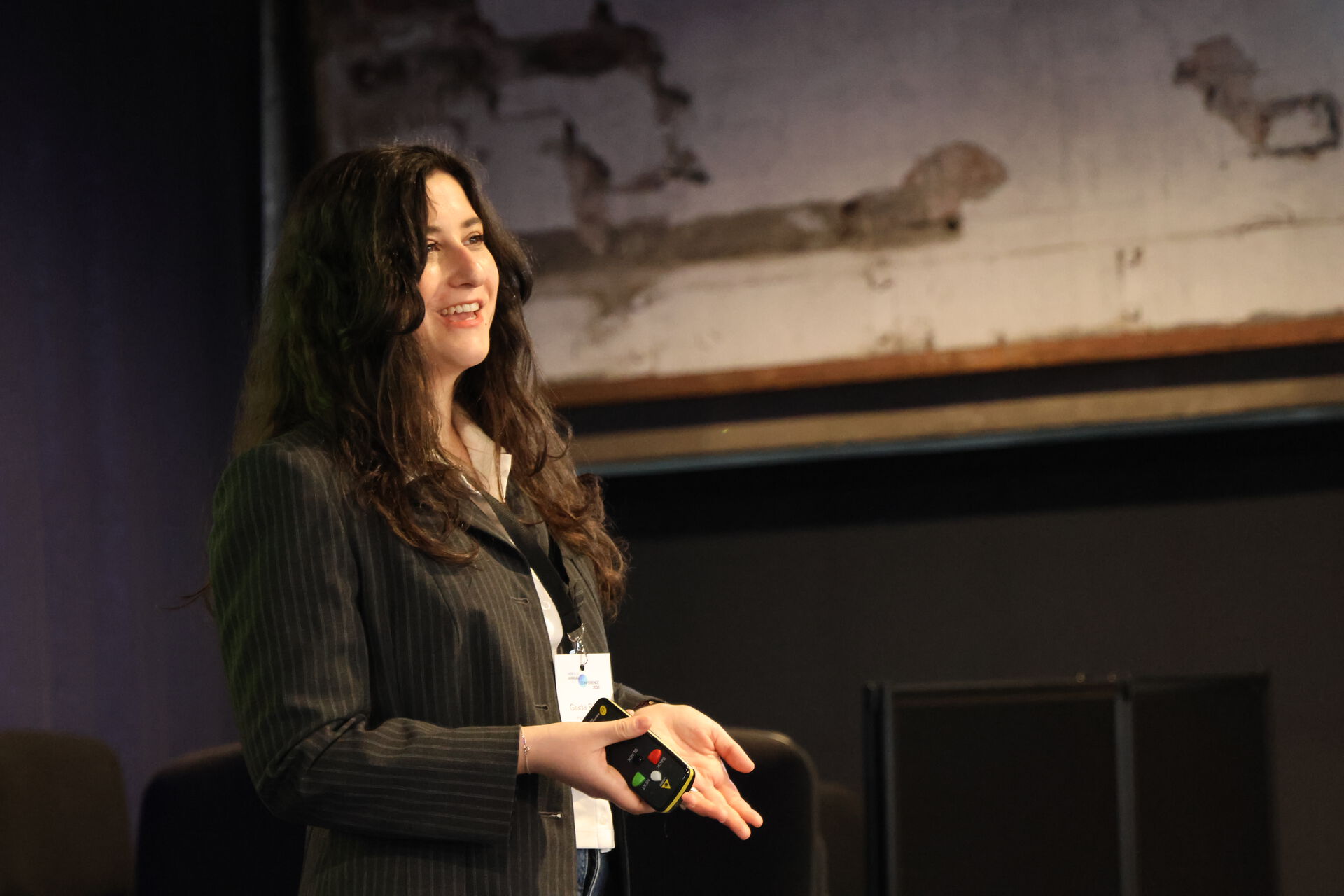
The first keynote was by Dr. Giada Pistilli, Principal Ethicist at Hugging Face. Her talk emphasized the importance of Ethics in AI, and stressed that ethics in AI isn't just a checkbox but it's about making deliberate choices that shape how technology impacts our lives and societies. As Large Language Models (LLMs) become integrated into our daily activities, we face important questions about their development and deployment.
The second keynote was by Prof. Robert Jenssen - Director of Visual Intelligence, UiT. Prof. Jenssen presented some basic principles for multimodal learning (MML). Then he talked about aspects of eXplainable AI (XAI) in the context of MML. The third part of the talk presents ideas for developing self-explaining MML by learned masks for classification purposes. The aim is to identify the most informative features within each modality that influence predictions. This is potentially important for users, for reliability and trustworthiness.
Prof. Lilja Øvrelid, Leader of the Language Technology Group at UiO, presented NorEval, a comprehensive benchmarking suite for evaluating Norwegian LLMs. Her talk addressed the need for systematic assessment of language models tailored to Norwegian linguistic standards, including Bokmål and Nynorsk.

Svein Arne Brygfjeld, Head of the AI Lab, National Library of Norway talked about Norwegian language models. As a measure to ensure access to language models that better reflect the Norwegian language and Norwegian society, the Norwegian Parliament (Stortinget) has allocated 40 million Norwegian kroner in the 2025 national budget for the National Library of Norway (NB) to deliver language models for free use by all parts of society. The models will support variants of Nynorsk and Bokmål, as well as Sami languages.
Hans Eide, Special Adviser for User Services, Sigma2 talked about that we need to adopt latest developments in order to stay competitive globally, safeguard the environment and resources, and deliver the best services to customers and citizens. This requires access to vast computational resources and expertise. Equally important is ensuring a seamless and efficient transfer of knowledge and development between research, society, and industry. He aslo provide insights into Norway’s computational resources—both existing and upcoming—as well as the expertise and support services available, including the forthcoming LUMI AI Factory.
Michael Riegler, Head of AI at Simula, examined how the multimodal nature of modern AI systems introduces novel considerations for alignment research. He explored how different modalities might interact in ways that complicate traditional alignment approaches, from potential divergences in concept grounding across modalities to emergent behaviors that arise from modal interactions. He gave special attention to three key challenges: ensuring consistent ethical behavior across modalities, developing effective oversight mechanisms for multimodal systems, and addressing potential failure modes unique to cross-modal learning.
Anita Schjøll Abildgaard, CEO Iris.ai talked about Iris.ai, which is Norway’s first AI startup. In the talk, she walked through their journey - both from a startup, technology and research perspective. The ups and downs, the past and current challenges and the opportunities that lie ahead.
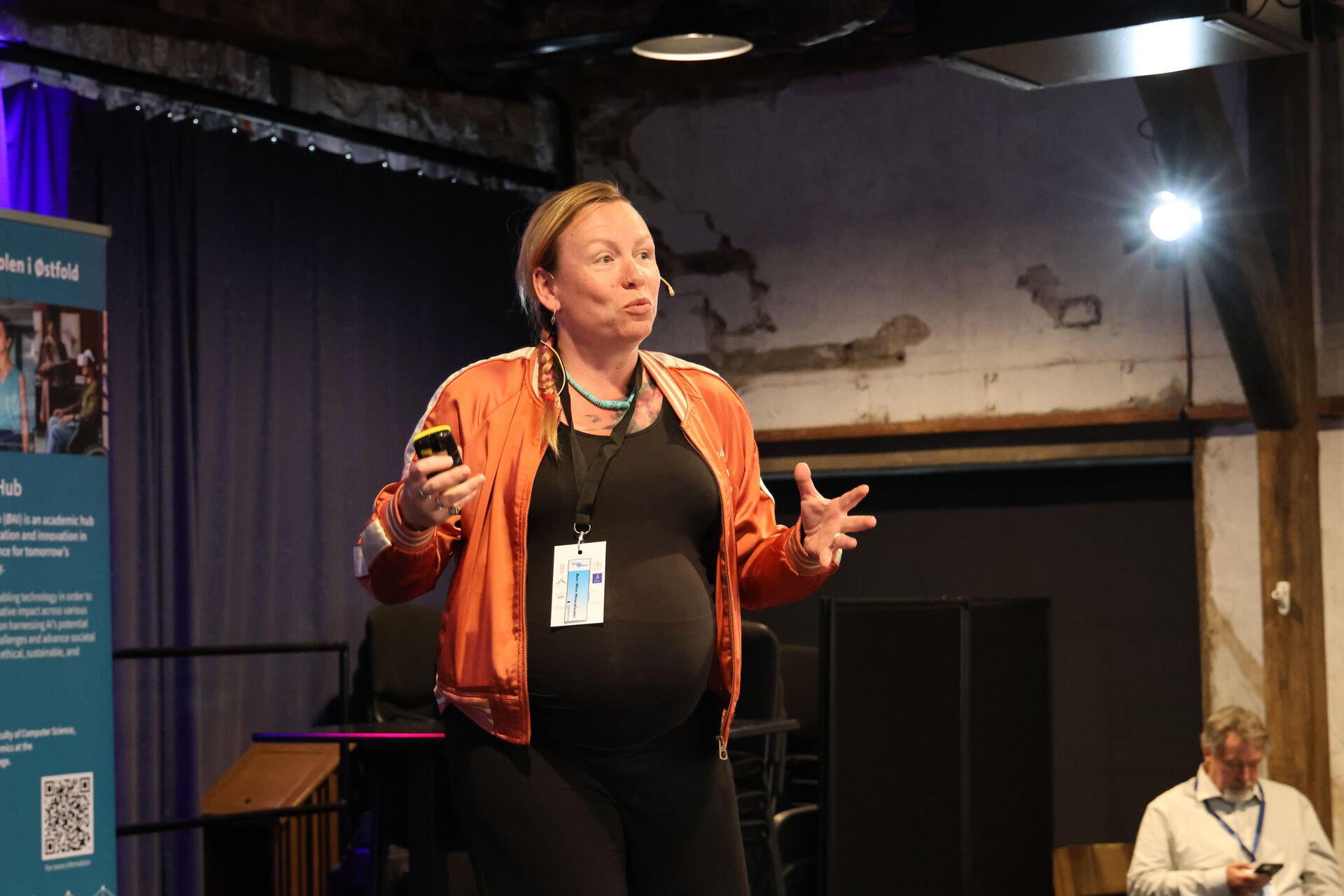
Assoc. Prof. Erlend Aune, CTO HANCE talked about how HANCE works with smaller quasi causal models, capable of running efficiently on mobile devices in real-time. He touched upon the design choices they meet when making new models, and how we address training of these models. Throughout the presentation, he gave examples of models, how they work, and which application they are intended for, while connecting these applications to the design choices they face when making the models.
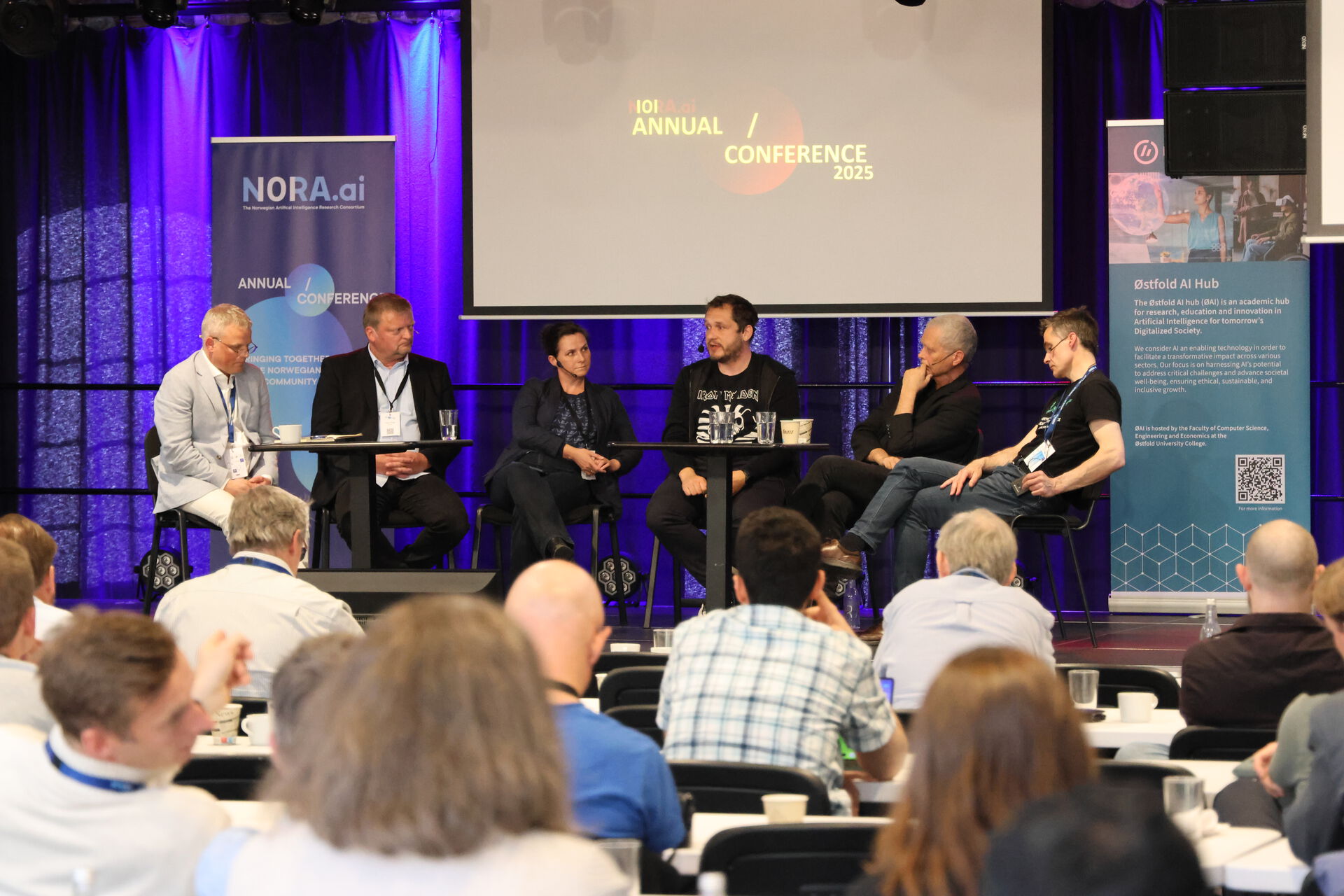
Furthermore, a panel discussion was held with the title Norwegian founation models, with Lilja Øvrelid, Svein Arne Bygfjeld, Hans Eide, Michael Riegler, Robert Jenssen and Klas Pettersen as moderator. They discussed technological sovereignty, national security, and responsible deployment. With the rise of large foundation models and agentic AI systems, the stakes are rapidly increasing. Many now argue that AI models and systems are becoming critical national infrastructure—alongside the data centers, compute resources, and electricity that power them. The panel discussed what level of control should the nation retain—from pretraining to fine-tuning to deploying full AI agents? And how should we address the growing safety and security risks posed by increasingly autonomous AI systems?
Keynotes and Talks on the second day
The second day’s first keynote was held by Prof. Irina Engeness, from the Dept. of Languages, Literature and Culture, HiOA. She explored and examined the benefits and dilemmas of AI in education. She considered AI’s role in assessment and feedback, it’s impact on student engagement, and the growing reliance on generative AI for content creation. Additionally, she addressed concerns about the devaluation of human expertise, the risks of bias in AI-driven decision-making, and the broader implications for academic integrity and independent learning. She aimed to provide a nuanced perspective on the future of AI in education: Are we approaching a tipping point of another wave of technological disruption, or will AI cause fundamental transformational changes in the educational landscape?
Prof. Samuel Kaski, Leader of FCAI and ELLIS Institute Finland, gave a keynote about Fundamentals of Applied AI. Prof. Kaski talked about how improving the very engine of R&D (research and development) with machine learning, we can contribute to solving a large number of problems with domain experts of the respective fields. This however requires contributions from a strong international network of collaborators in academia and industry, and solutions to fundamental machine learning problems that I call the Fundamentals of Applied AI. Prof. Kaski discussed in particular collaborative AI for human-AI teamwork and out-of-distribution transfer, and how this work is being carried out as collaboration of FCAI, ELLIS Institute Finland, Manchester Centre of AI Fundamentals, and their international partner network.
Prof. Amy Loutfi, Program Director of WASP explored how embodied AI — intelligent systems that learn through physical interaction —c an be enhanced by integrating human-inspired traits like curiosity and play. Drawing from her research at Örebro University and Linköping University, she discusses how these traits enable robots to adapt to real-world environments, improving perception, reasoning, and human-robot collaboration. As a Wallenberg Scholar, Loutfi's work advances AI's capacity for autonomous learning and interaction.

Prof. Anna Smajdor, Practical Philosophy Group, UiO talked about Datafication and the Midas touch: ethics in AI-enabled healthcare and beyond. The ethical response so far has focussed on the need to bolster privacy, anonymity and confidentiality, stripping sensitive data of its connections to the individuals from whom it originates. However, this detachment makes it easier for data to be commodified and exploited in ways that may not necessarily align with the original donors’ interests. Prof. Smajdor proposed a new approach to privacy and confidentiality. Instead of obliterating the links between people and their data, the significance of these connections should be recognized and preserved. In turn, this opens the possibility of offering individuals greater involvement and control over the AI technologies developed from their data. Ultimately, anonymisation is not ethically neutral: it feeds into a false perception of data as unclaimed property up for grabs.
At the end of day two a panel discussion was held with the title “From Paris to Halden – The AI Action Summit and AI in the Nordics” with Samuel Kaski, Amy Loutfi, Klas Pettersen, Giada Pistilli and Michael Solvang as moderator. The panel discussed how AI development can align with democratic values in an increasingly fragmented geopolitical landscape. Amid growing concerns about digital sovereignty, data control, and technological dependency, the discussion will focused on how the Nordic model—rooted in trust, openness, and strong public institutions—can help shape a human-centered AI future. The panel will also reflect on insights from France and the broader European context.

Poster sessions
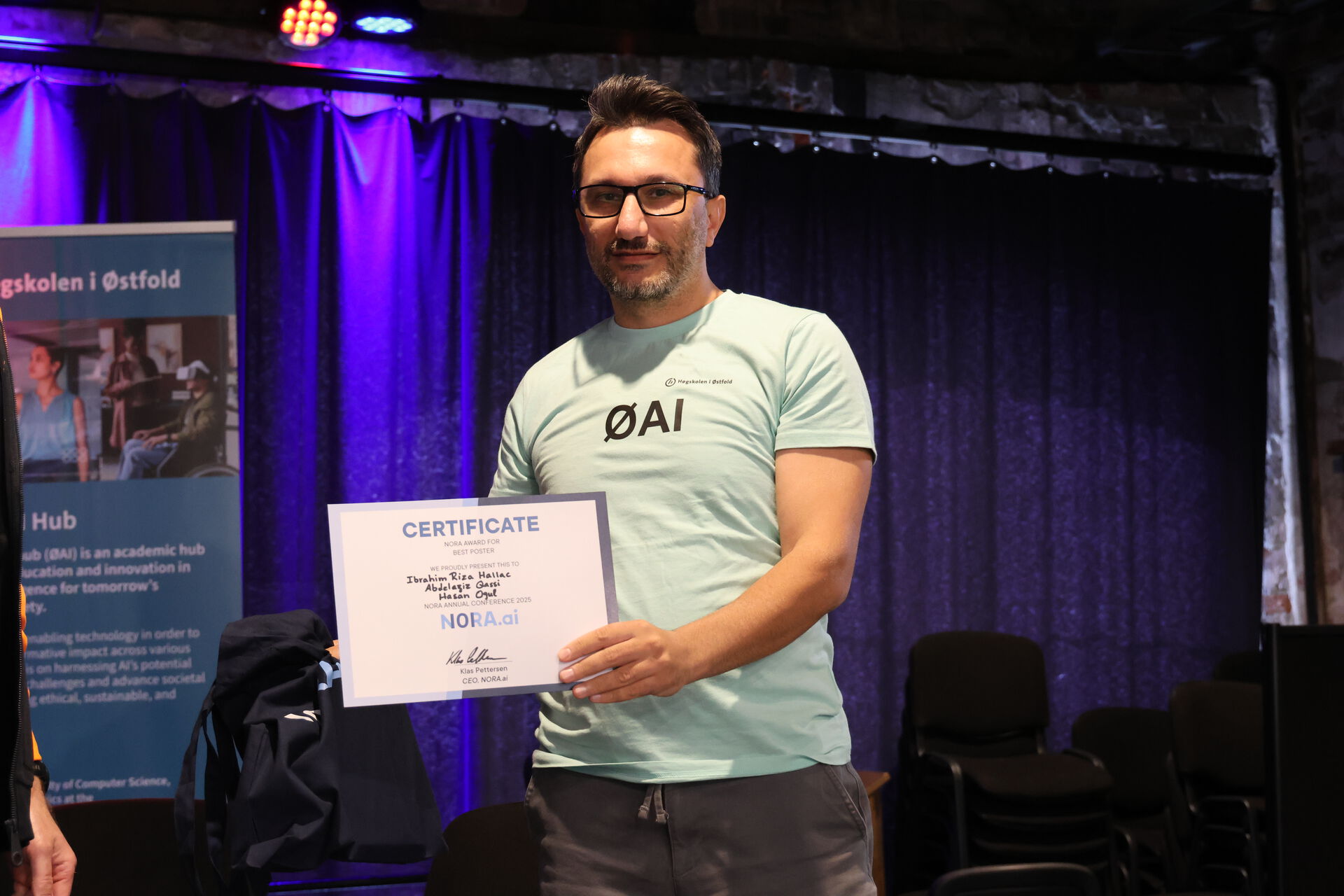
Two poster sessions were held during the conference, showcasing cutting-edge research from across Norway on topics such as AI in healthcare, sustainable technologies, and human-centered design. Congratulations to the winners of the Best Poster Award: Ibrahim Rıza Hallac, Abdelaziz Qassi, and Hasan Ogul for their work on "Detecting AI Influence in Student Writing: Toward Reliable and Interpretable Classifiers."
We’d also like to congratulate the runner-up team: Aaron De Leyos, Alexander Stasik, and Signe Riemer-Sørensen, for their excellent poster "Probabilistic Kolmogorov–Arnold Networks with Gaussian Process Activations for Uncertainty Quantification.
NORA Annual Awards
At the NORA Annual Conference, NORA Awards were handed out. The NORA Awards are an annual recognation and tribute to the Norwegian AI Community. The NORA awards are handed out in six different categories; Lifetime achievement, Early career investigator, Community building and education, Diversity in AI, Publication of the decade 2014-2015 and Startup. The winners were:
-
Lifetime Achievement award: Michael Riegler, Head of AI at Simula
-
The Early Career Investigator: Mikkel Lepperød, Researcher at Simula
-
Community Building and Education award : Inga Strümke, Assiciate Professor at NTNU
-
Diversity in AI Award: Lars Ailo Bongo, Professor at the UiT - Universty of Tromsø
-
Publication of the Decade 2014-2024: Umuroglu et al. (2017); Finn: A framework for fast, scalable binarized neural network inference
-
NORA.Startup Award: Mynder
Networking and sosial aspect
The conference also served as a social hub for the Norwegian AI community. A dinner event at Fredriksten Hotel on the evening of June 2 featured the NORA Awards, live music, and ample opportunities for informal networking. The event underscored NORA’s commitment to fostering a collaborative and inclusive AI ecosystem.

See you next year!
The 2025 edition of the NORA Annual Conference reaffirmed Norway’s growing role in ethical, inclusive, and impactful AI development. With strong representation from academia, industry, and government, the event highlighted the importance of cross-sector collaboration in shaping the future of AI.
We would like to use thank all participants for making the NORA Annual 2025 a great success. NORA Annual Conference 2026 will be held in Oslo on 1st and 2nd of June. Stay tuned for more information!