Looking at my research through a different lens
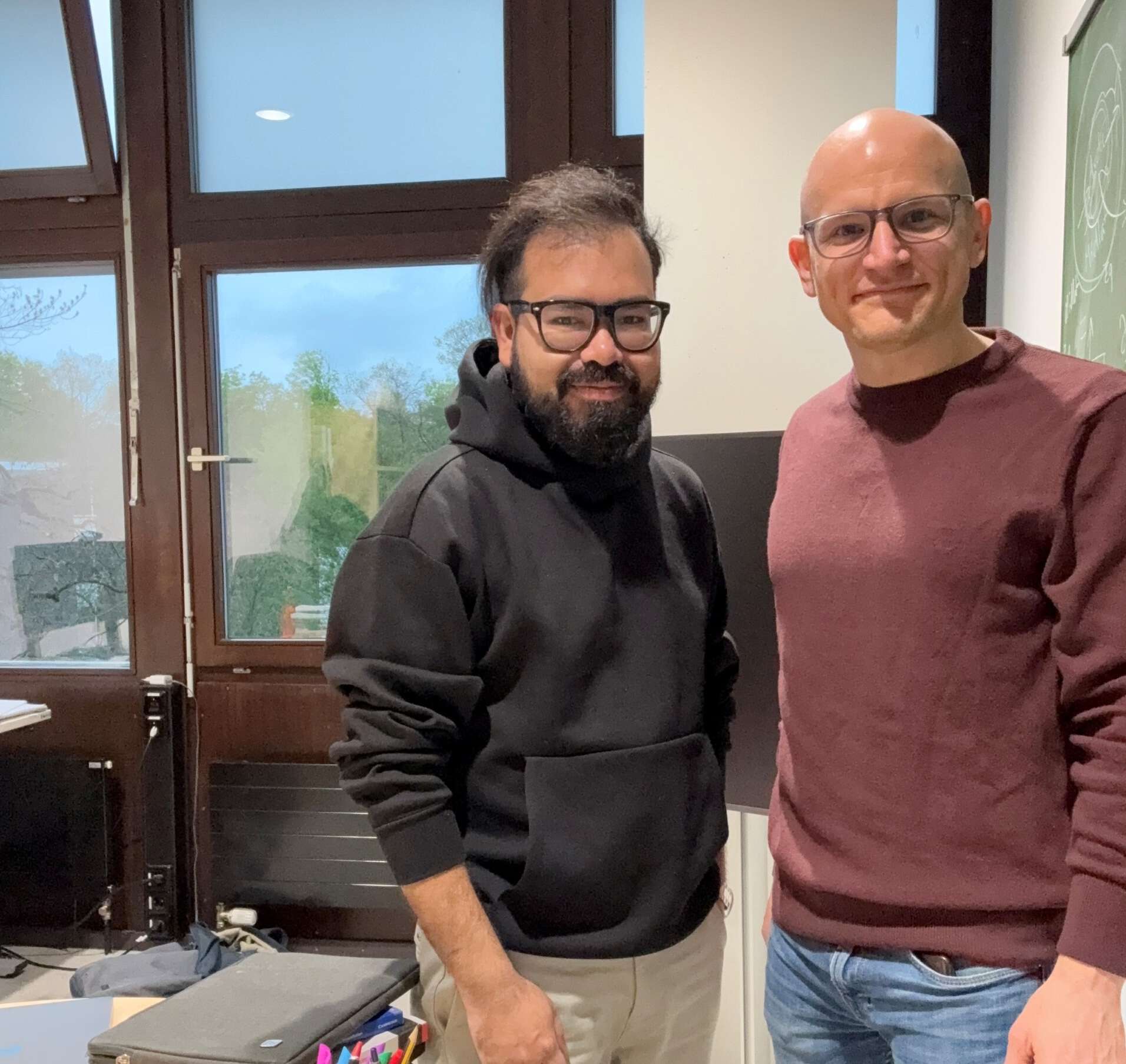
At KIT, I worked with Professor Sebastian Krumscheid’s research group, whose work focuses on uncertainty quantification and related mathematical and computational methods.
My own PhD research at the University of Oslo comes from a somewhat different direction. I work with reliable AI systems for Digital Product Passports (DPPs)—digital records that can contain information about a product’s materials, sustainability characteristics, technical properties, and compliance information. My research explores how technologies such as language models, retrieval, persistent memory, and symbolic reasoning can make this information easier to access while keeping answers grounded, traceable, and reliable.
That difference in research backgrounds was exactly what made the exchange valuable.
Rather than travelling to Karlsruhe simply to continue doing the same work from another desk, I had the opportunity to examine familiar research questions from a different perspective.
We began with introductory meetings where I presented my work and learned more about the research being carried out within the group. One particularly useful session was a discussion with Professor Krumscheid about uncertainty quantification, his previous and ongoing research, and the assumptions behind the numbers that computational models produce.
The conversation left me thinking about a deceptively simple question:
What happens when the uncertainty is not only in the model, but already in the data we give it?
When the data itself may be uncertain
Consider something as seemingly straightforward as a carbon-footprint value in a product record. An AI system might retrieve the value correctly, reason over it correctly, and even express high confidence in its answer.
But what if the original value was systematically distorted?
Real-world data can come from different suppliers, laboratories, regions, measurement systems, and reporting practices. Some values may be missing, while others may be available but affected by measurement or reporting bias. In such cases, a system can be very precise and still be confidently centred on the wrong quantity.
Discussions during the KIT visit helped develop this observation into a new research direction that I am currently working on and that remains in the pre-publication stage.
What happens when the uncertainty is not only in the model, but already in the data we give it?
The idea is to treat recorded values not automatically as unquestionable truth, but as observations of an underlying quantity that may itself need to be inferred. Instead of asking only, “How uncertain are we about this recorded value?”, the work asks something closer to: “Given how these data may have been measured or reported, what underlying values remain plausible?”
The framework I am developing represents possible clean values and systematic measurement bias explicitly and then quantifies uncertainty over them under transparent constraints. Importantly, this is not about claiming that an algorithm can magically reconstruct a single hidden “true” dataset. The assumptions used in the correction must remain visible and auditable.
This connects naturally to my broader PhD work. Reliability in AI is not only about whether a language model produces the right sentence. It also depends on whether the evidence beneath that sentence deserves our confidence.
For me, that was one of the most important outcomes of the exchange. A discussion between researchers working from different perspectives turned into a question that connects uncertainty quantification with my work on reliable data-driven AI.
And, as research tends to do, one useful conversation created considerably more work for the future.
Beyond equations and meeting rooms
A research exchange is, of course, not made entirely of papers, equations, and meetings.
Karlsruhe was a very enjoyable place to spend this period. I found KIT to have an active and international student and research community, and I particularly appreciated the openness of the academic environment. Conversations did not always remain confined to research. They moved easily between science, university life, travel, cultural differences, food, and the everyday experience of being a researcher in another country.
Whenever the research schedule allowed, I also explored Karlsruhe and travelled to other parts of Germany. Leaving the office occasionally turned out to be useful for research as well: a different city, a long walk, or an informal conversation can sometimes provide exactly the mental distance needed to look at a stubborn problem differently.
Travel also provided its own practical lessons in uncertainty quantification—particularly when estimating the arrival time of a German train.
More seriously, spending time in another academic environment reminded me that some of the most valuable research exchanges happen outside formal presentations. A question after a meeting, a discussion over coffee, or someone approaching a familiar problem from a completely different discipline can sometimes change the direction of a project.
Coming back with new questions
I went to KIT expecting to learn more about uncertainty quantification. I certainly did.
But I returned with something more useful than simply another method to add to my toolbox. The experience changed how I think about reliability in my own research. It encouraged me to look beyond uncertainty in AI-generated answers and ask more fundamental questions about uncertainty, bias, and reliability in the information on which those answers depend.
The stay contributed to a new paper idea that is now being developed, introduced me to another research community, and gave me the opportunity to experience academic life at KIT as well as Karlsruhe and Germany beyond the university.
Perhaps that is the real value of research mobility. It is not only about moving researchers between institutions. It is about moving ideas between disciplines.
My KIT exchange began with some uncertainty. It ended with new research questions, new connections, good memories—and, appropriately enough, a little more certainty about where I would like to take my research next.