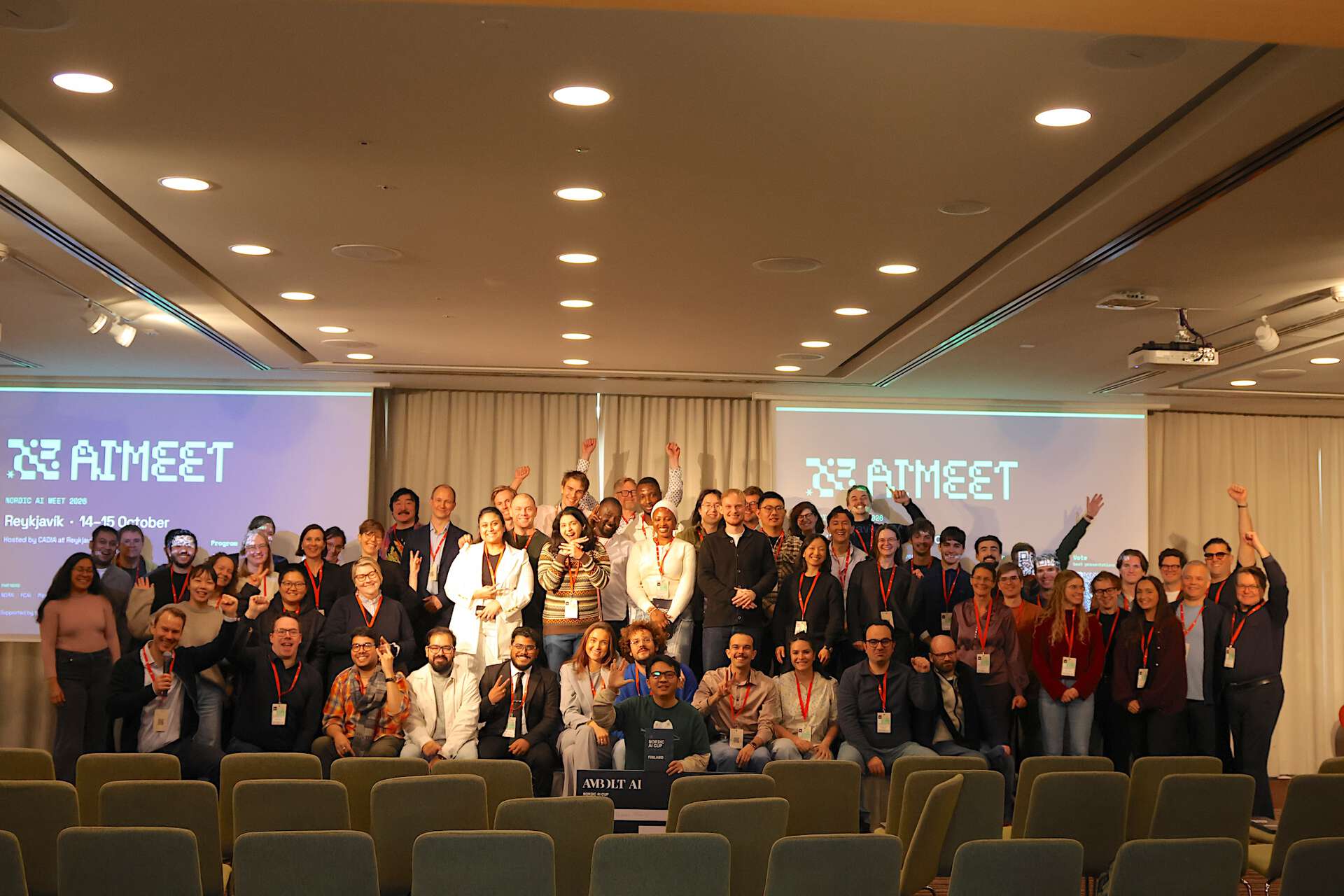
The Nordic AI Meet is a good place to be. There is a strong sense of community, and people seem to enjoy both meeting their Nordic colleagues and exploring opportunities to collaborate across borders.This year, we were happy that we got to take the meeting to Iceland, where it was hosted by CADIA (Center for Analysis and Design of Intelligent Agents) at Reykjavik University. With that, NAIM has toured all the Nordic countries since it started in Norway in 2021, and will return to Norway in 2027.
The Reykjavik meeting attracted around 100 attendees. The main program followed the same overall structure as previous editions of the meeting. It consisted of a plenary part withfive keynote talks and one industry talk, and a part based on sent-in abstracts, which included 24 oral session talks running over two parallel tracks and 43 poster presentations.
The local host, Stefán Ólafsson (CADIA), hosted the event with a good mix of authority and Icelandic informality. He made sure that speakers kept both their calm and their time and that the non-vegans kept their hands off the lunches that were specially prepared for the vegans. He opened the meeting by pointing out to everybody that it was a windy day. Most of us had already realized this, but it felt reassuring that also an Icelander saw it that way. Fortunately, the wind died down during the day, which allowed those with such interests to take a dip in the nearest hot spring to freshen up before the conference dinner. During the dinner, the wind returned with renewed strength, making our walk back to the hotel an authentic Icelandic experience.
Social Sciences Focus, Nordic AI Cup and A Visit From the President
Three new elements were added to this year’s meeting:
First and foremost, the Icelandic president Halla Tómasdóttir honored us by taking time out of her busy schedule to join our meeting for a fireside chat with Kristinn R. Thórisson, AI researcher and co-founder of Iceland's CADIA. Professor Thórisson and President Tómasdóttir discussed how we can use AI for good in the Nordics. The president said that she feels a sense of urgency for the Nordics to act and collaborate on AI safety. Honored by her visit, the NAIM organizers brought presents for the president. From NORA, she was given a cheese slicer and a piece of brunost. The original settlers on Iceland did not bring cheese slicers along from Norway as they had not been invented yet back then.

Secondly, to emphasize this year’s stronger focus on social sciences and humanities, a pre-meeting symposium was added to the program. The symposium, taking place in the evening on the day before the main meeting, had the theme Rethinking AI, and was put together by Lisa Reutter Larsen, Charlotte Högberg, Ellinor Blom Lussi, Guri Barka Martins and Laura Savolainen.

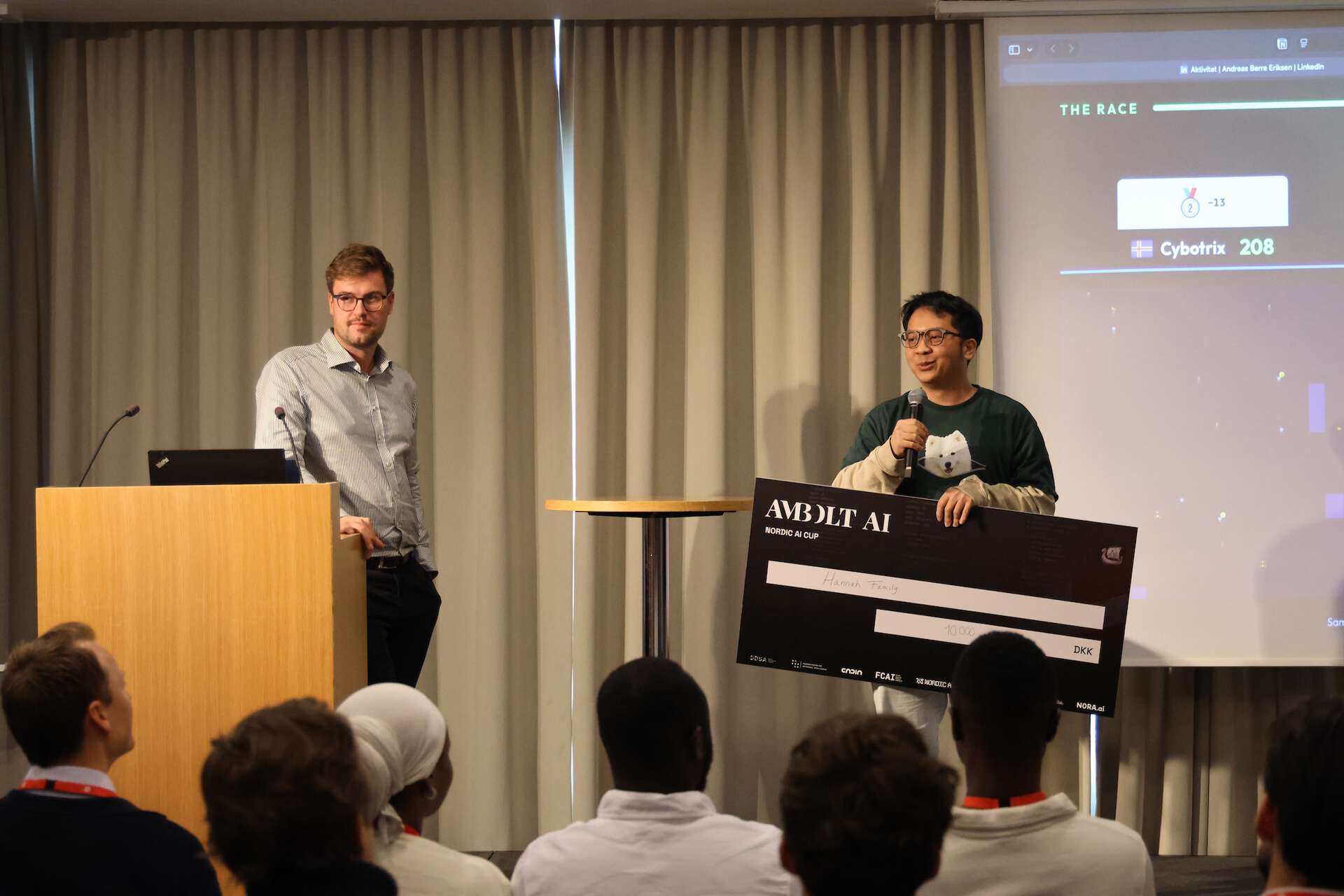
Thirdly, this year saw the first Nordic AI Cup final. Winning teams from national qualification rounds in Norway, Sweden, Denmark, Finland and Iceland gathered in Reykjavík for an intense 24-hour competition, while the rest of us listened to keynote talks, visited posters and enjoyed a good night’s sleep.The task for the competing teams was to train an AI model to play a pacman-like game. The conference concluded with the trained models competing on screen, allowing everyone to watch the winner emerge in real time.
The AI Cup was not so much about crowning a winner as about bringing young AI talents from across the Nordics together in a friendly competition. It was therefore pleasing to see the competitors dine together during the competition, form friendships, and go on joint trips afterwards. That said, it must still have felt great to win the thing, so let us congratulate the Finnish team of one - Hannah Family, or Yue Fang, a PhD student at Aalto University! Let us also thank Ambolt AI for their great work in organising the Nordic AI Cup.
Thought-Provoking Keynotes
Going back to the main programme, we had five great keynotes and one industry talk this year:
Focusing on the difficulties in dealing with biases in medical data, Aasa Feragen (Technical University of Denmark) gave a thought-provoking talk on whether it is responsible to do responsible AI in such irresponsible times. Although she joked that “the easiest way to get away from bias-problems is for everybody to be identical”, she also proposed other ways to deal with biases.
The Industry talk was given by Finnur Pind, co-founder of Treble Technologies. He presented their work on developing physics-based simulations that recreate acoustic scenarios and generate synthetic data for training AI models and evaluating their performance.
Stockholm-based Leonora Vesterbacka presented Redpine’s initiative to build the infrastructure for making data that is outside of the internet available for AI, and at the same time make sure that the people who created it get paid.
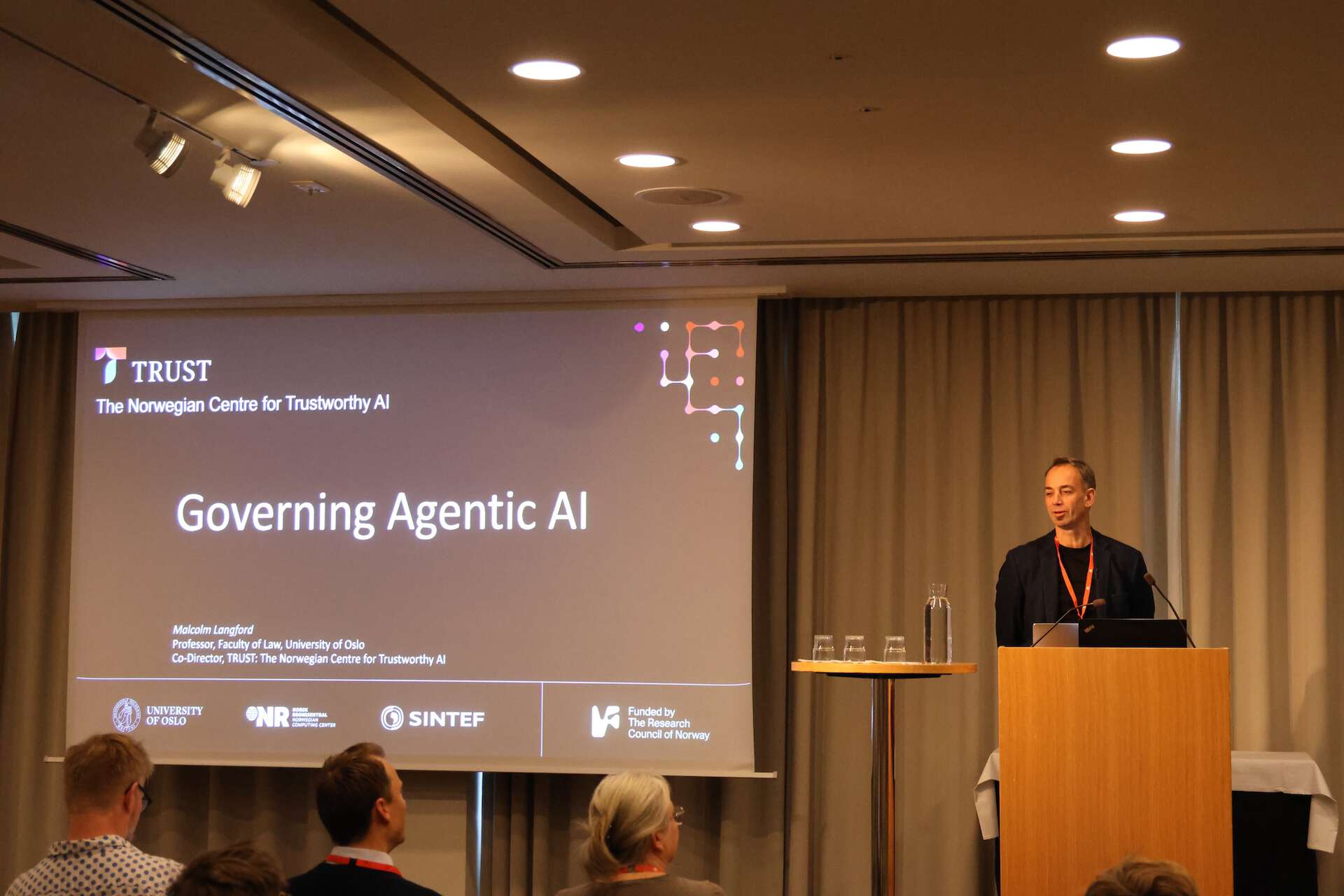
Following Malcolm on stage, Dorota Glowacka (University of Helsinki)j oked: “I like to speak to lawyers as long as I am not the subject of the conversation.”After that, she followed up with a talk where she summarized bodies of AI research on(a) helping users explore massive text and image collections, (b) helping lawyers to model the tradeoff between privacy and security in algorithmic surveillance systems, and (c) examining usertrust (or the lack of such) in recommender systems.
Finally, Iris Edda Nowenstein (University of Iceland and the National University Hospital of Iceland) gave a talk where she explored how insights from language science can serve as a compass when navigating the jagged AI frontier.
Best Poster and Oral Presentation
The parallel oral sessions and poster presentations were too many to summarize here, but as usual, the attendees of the Nordic AI Meet voted for the best presentations among these:
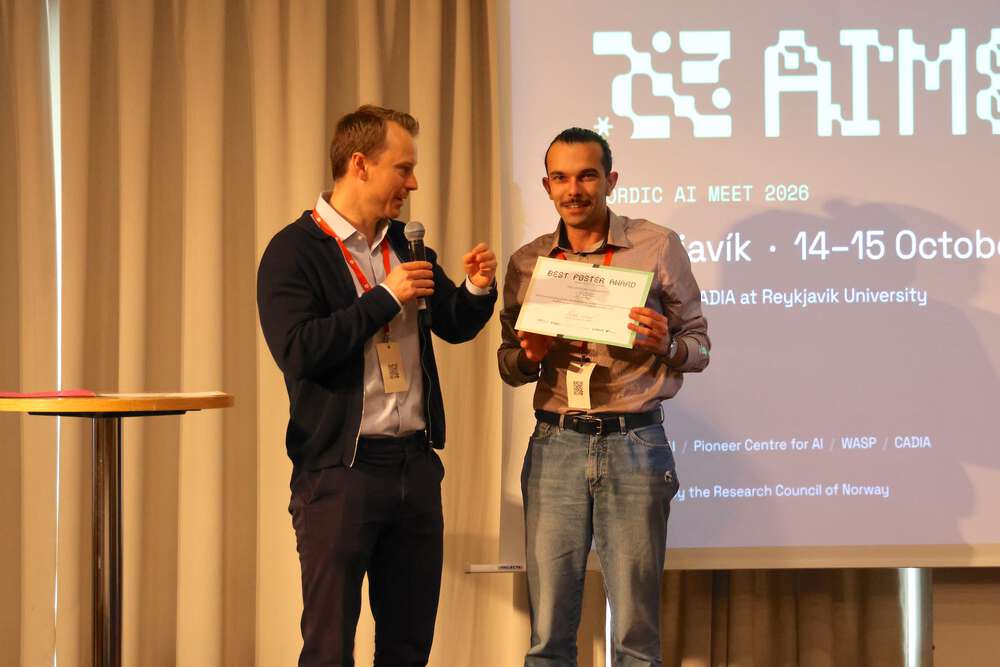
The award for the best poster presentation in NAIM 2026 went to Leroux Baptiste (with co-authors Torfi Þórhallsson and Jón Guðnason) at Reykjavik University, Iceland, for the poster on From Sign to Speech: A Low-Resource Route for Icelandic Sign Language.
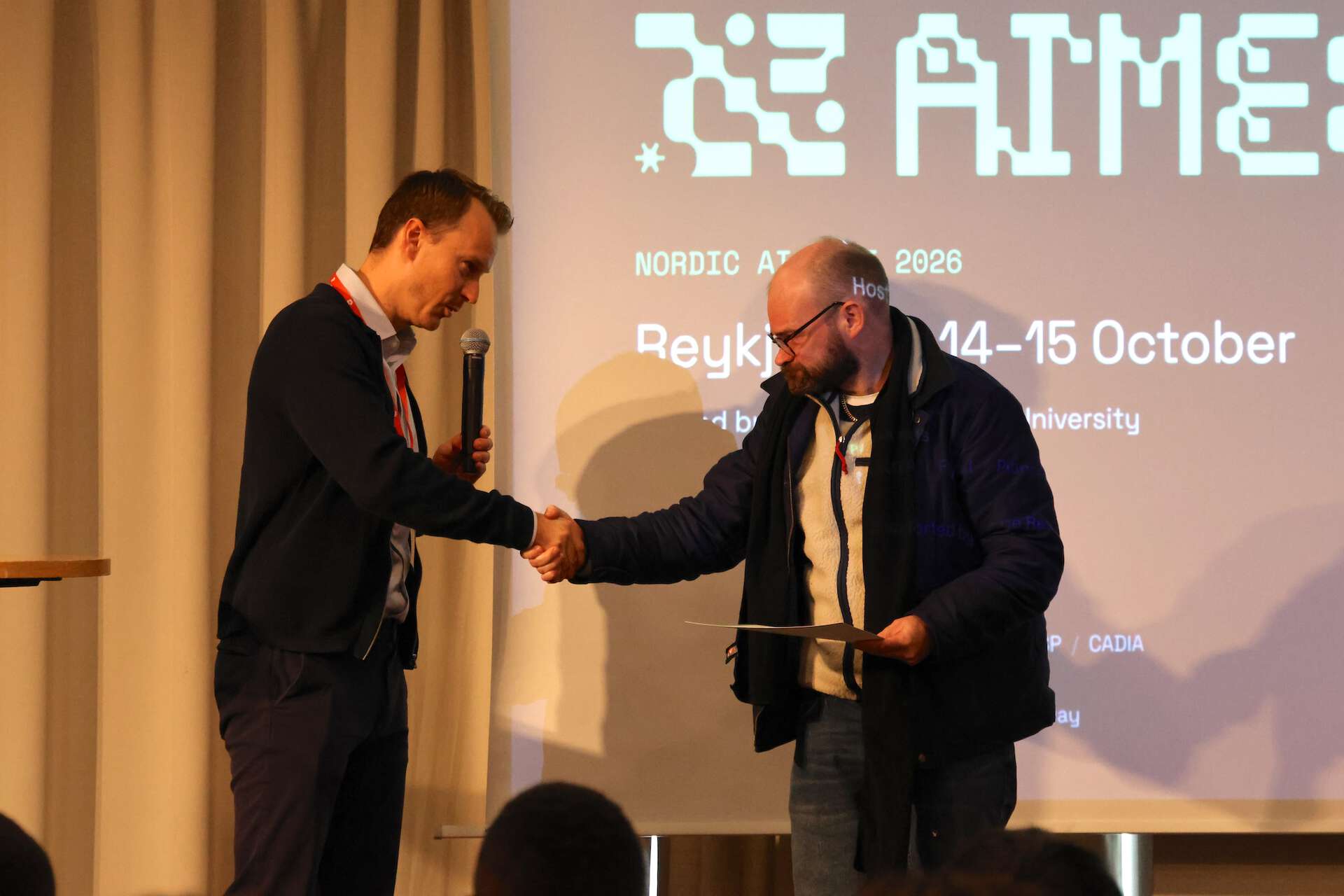
The award for the Best Oral Session Talk went to Andrew Leyden from Örebro University, Sweden, for the talk Legitimacy in Tension: Who Governs Fundamental Rights under the AI Act?
Receiving the awards, Leroux said that he was only five months into his PhD, and that it was a great honor to receive such an award at such an early stage. Following Leroux on stage, Andrew joked that since he was approaching the end of his PhD, it was probably about time that he received such an award.