
The Lifetime Achievement award went to Michael Riegler, Head of AI at Simula:
- This award is not mine alone, but it belongs to everyone in our AI community who chooses collaboration over competition, transparency over black boxes and human values over pure efficiency, said Michael Riegler upon receving the award.
Riegler has been a central figure on the Norwegian AI scene in the last years and contributed significantly to public dissemination and the public debate, progressing the state-of-the-art in medical AI, promoting open and reproducible research, and focusing on the societal benefits of AI. He has been recognized as an outstanding researcher documented by its membership in the Young Academy of Norway.
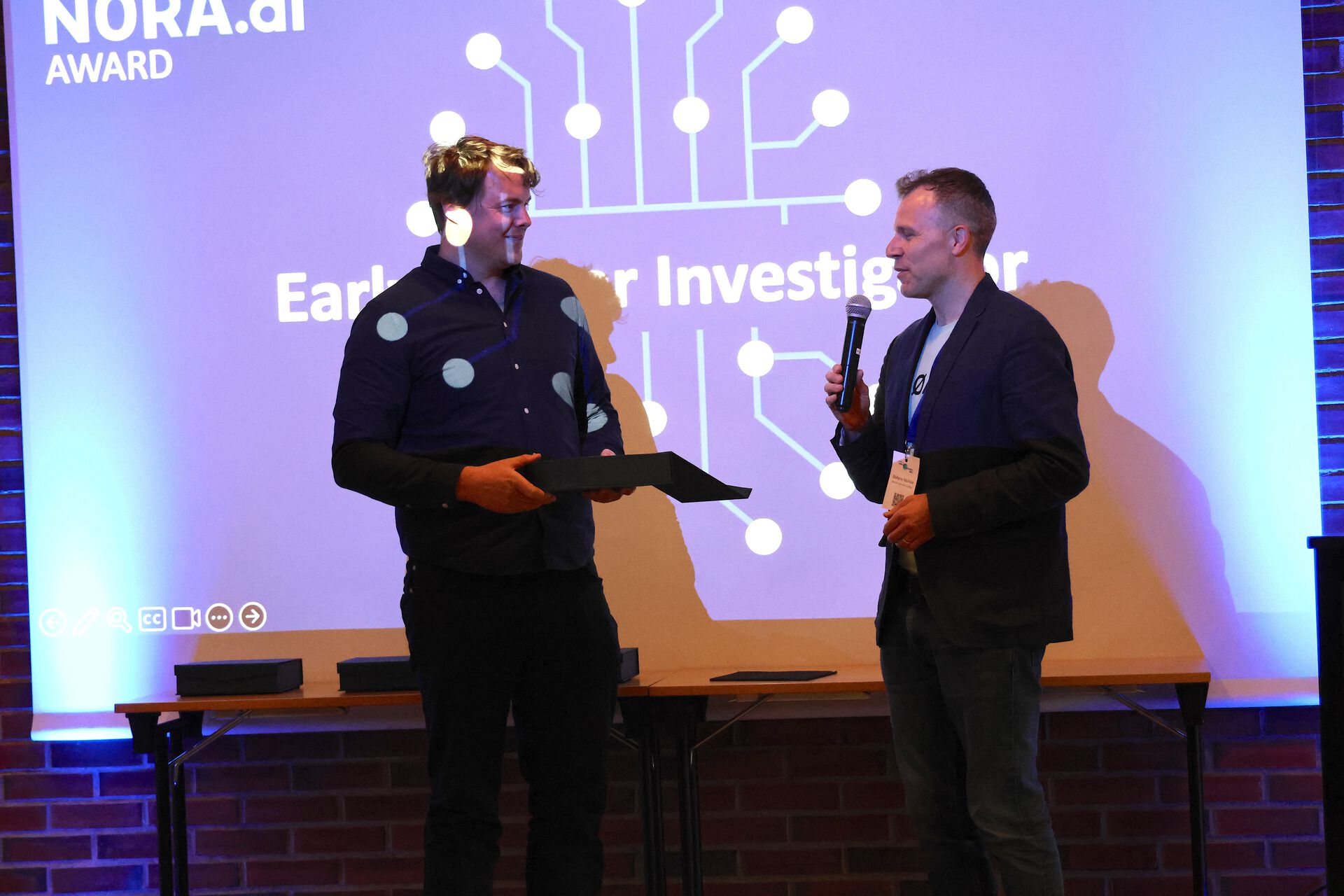
The Early Career Investigator award went to Mikkel Lepperød at Simula. Lepperød is a research scientist and group leader of the BioAI group at Simula.
- Receiving the NORA early career investigator award is a tremendous honor — for me personally, and for the community I represent. It acknowledges not just my work, but the collective effort of my students, collaborators, and mentors who together have shaped our vision for NeuroAI. For me, this award is a vote of confidence that encourages me to keep pushing the boundaries between neuroscience and AI. For the NeuroAI community in Norway, it signals growing recognition of our field’s importance and potential, said Mikkel Lepperød upon receving the award.
- This award will help me further build and connect the NeuroAI community—bringing together researchers from both AI and neuroscience to tackle the deep questions of intelligence. I hope it inspires others to join this exciting interdisciplinary effort, Lepperød continued.
Lepperød is a community builder, which is considered a very important aspect for young researchers that contribute to the growth of the scientific community as a whole. He has a publication track record that includes top conferences in AI/ML, such as NeurIPS. He has served as Principal Investigator in large projects, and leads a group of 11 researchers.
The Community Building and Education award went to Inga Strümke, Assoiciate Professor at NTNU.
- Norway has five new AI centers on the way, and we are educating students with AI expertise at an increasing number of institutions. There is a good chance that Norway can become a nation that can use AI to make lives better, said Inga Strümke in a message, as she could not be present at the Award Ceremony.
- I am simply incredibly grateful to be part of this community, and extra flattered and grateful to receive NORA's award for Community Building and Education, she continued.
Strümke is recognized as one of the most prominent and prolific AI disseminators and educators in Norway, as demontrated by the several awards for of her efforts and engamentent in the dissemnation of difficult AI topics in a simple manner to the general public.
The Diversity in AI Award went to Lars Ailo Bongo, Professor at the Universty of Tromsø. Prof. Bongo is part of the Sámi people, and represents Indigenous excellence in AI and academia.
- I am very happy to both have been nominated and receive the NORA Diversity in AI award. I think we all have recently realized how important diversity, equity, and inclusion are in research, and why it is important that Norway takes a lead in making AI DEI. Therefore, I think it is important that minorities such as the Sámi are involved not just as stakeholders, but also as researchers and research leaders. I therefore hope that there will be more Sámi AI projects in Norway, said Lars Ailo Bongo upon receving the award.
Lars Ailo Bongo serves as a trailblazer for underrepresented Indigenous groups in AI, inspiring the next generation of researchers. His presence in academia not only increases visibility for Sámi and other Indigenous scholars, but also helps dismantle barriers in a field where Indigenous perspectives are often marginalized.
Recent news that the Norwegian Parliament has asked the Norwegian government to ensure that Sámi AI work is included in the Research Council of Norway’s focus on research centers for artificial intelligence (AI centers), further emphasizes the importance of diversity in AI.

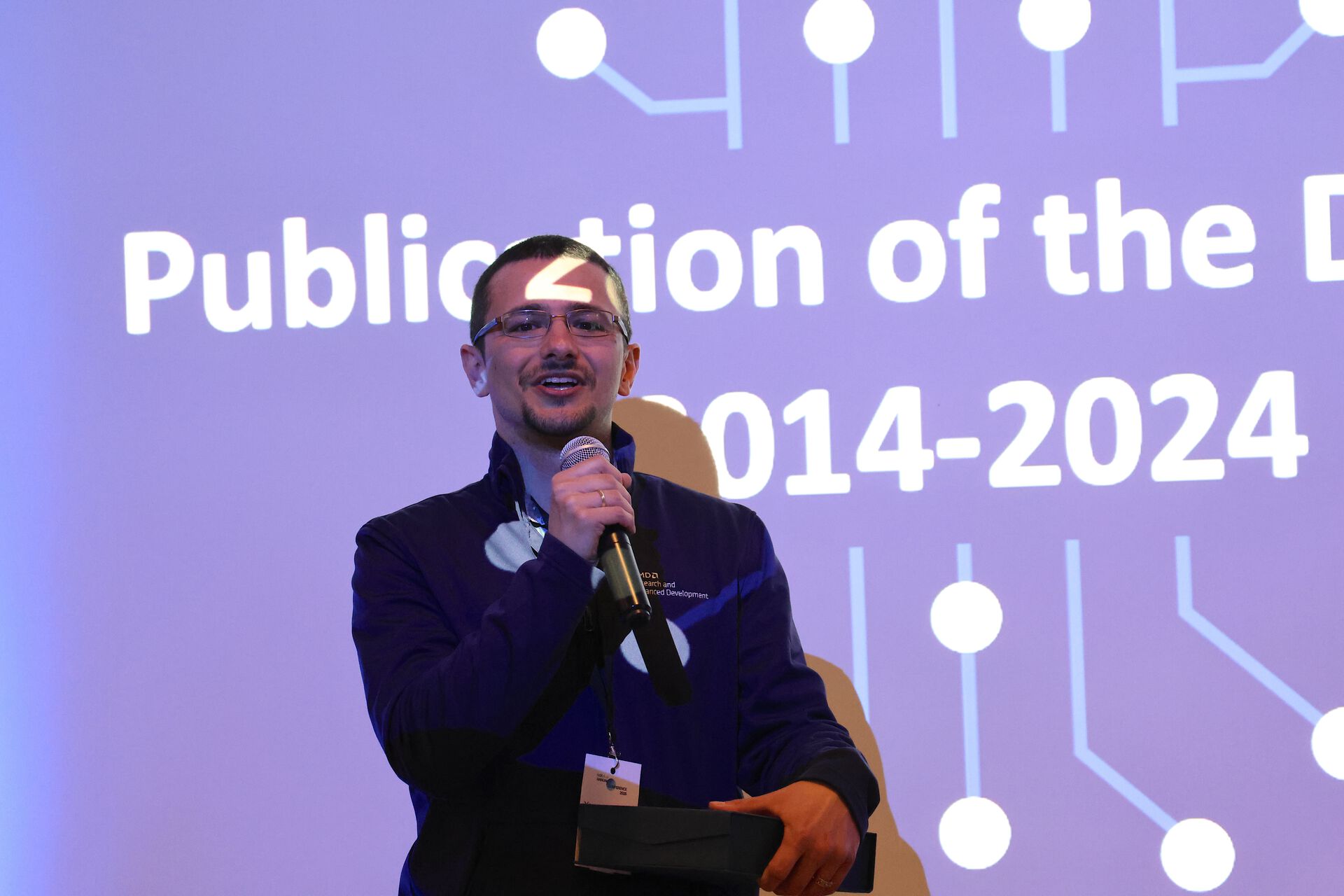
The Publication of the Decade 2014-2024 went to Umuroglu et al. (2017); FINN: A framework for fast, scalable binarized neural network inference. The paper is a highly influential work, cited over 1,000 times. It presents an approach that tailors computational resources at the neural network layer level to meet user-defined throughput requirements. This makes it particularly well-suited for real-time embedded systems such as robotics, augmented reality, surveillance, etc. The authors demonstrate that Binarized Neural Networks (BNNs) can be deployed at scale with high efficiency using custom hardware accelerators on FPGAs. The work was published at a reputable conference, further attesting to its significance.
- The FINN co-authors and I are honored to receive this award. This paper on creating dedicated hardware accelerators on FPGAs for quantized neural networks for edge AI helped lay the foundation for the open-source FINN project, which today boasts a vibrant community with significant academic and industrial interest. I believe our open-source, interdisciplinary approach has greatly contributed to our impact, and I am grateful to NORA for this recognition, said Yaman Umuroglu, lead-author of the paper and Principal Engineer at AMD Research.
The Startup Award went to Mynder. Mynder addresses a pressing and globally relevant issue: data privacy and cybersecurity.
- Being named Startup of the Year by NORA.ai is a great honor. We started Mynder to solve one of the biggest challenges of our time: privacy and data security. This is not just about GDPR and NIS2, but about national preparedness. Using AI to automate 90 percent of privacy work is not a lofty goal – it is entirely possible when we build on research and innovation. We are proud to be part of the NORA network and see this as confirmation that we are on the right track, said Synnøve Olset, Founder of Mynder upon receving the award.
In the current US political climate, particularly considering the security risks, as well as enforcement of GDPR, security and privacy compliance have become critical concerns for organizations. Mynder provides a platform that enables automatic risk assessment through AI-driven analysis, simulates potential data breach scenarios to enhance organizational preparedness, and offers tools to identify and mitigate risks associated with cloud services and third-party providers. Mynder is already an established player in this domain. The company addresses a real and growing global need, with a strong foundation not only in Norway but across Europe and internationally.
All categories were evaluated by a jury consisting of Stefano Nichele (leader, HiØ), Klaus Johannesen (NORCE), Samia Touileb (UiB), Ana Ozaki (UiO), Leonora Bergsjø (HiØ), Mina Farmanbar (UiS), Ana Ozaki (UiO) and Morten Goodwin (UiA).
- It’s been a privilege leading the jury of NORA-awards 2025. We have seen the immense and great work Norwegian researchers and scientist conduct in the field of AI. It was difficult to choose one winner in each category, because of the great work that is done. Having said that, the winners are well deserving and we hope NORA-awards will contribute to recognise their work and efforts, said Stefano Nichele, leader of the NORA Awards 2025 jury.

About NORA NORA – Norwegian Artificial Intelligence Research Consortium – aims to strengthen Norwegian research, education and innovation within artificial intelligence, machine learning and robotics, as well as other relevant research that supports the development and use of artificial intelligence. The NORA consortium was established on 21 November, 2018. The consortium consists of the following 17 partners: University of Agder, UiT The Arctic University of Norway, OsloMet – Oslo Metropolitan University, University of Bergen, Norwegian University of Life Sciences, Simula Research Laboratory AS, NORCE Norwegian Research Centre AS, University of Oslo, University of Stavanger, University of South-Eastern Norway, Kristiania University College, Western Norway University of Applied Sciences, Østfold University College, SINTEF, BI Norwegian Business School, University of Inland Norway and Norwegian Computing Center. There are also seven strategic partners: The Brønnøysund Register Centre, Posten, Norsk Helsenett, Ruter, Vestfold Hospital Trust, NAV and Tine. |