Norwegian
version of this page
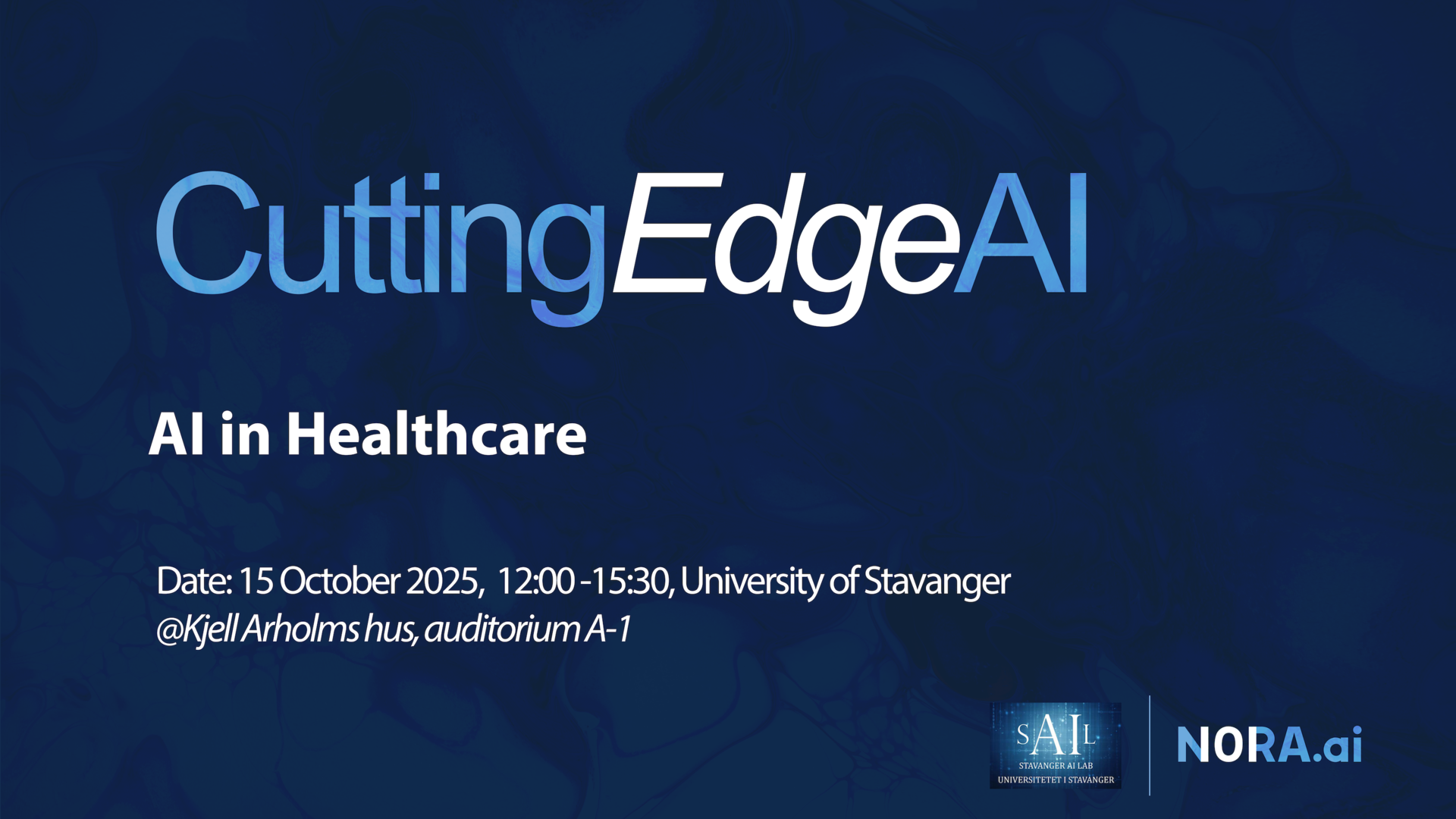
CuttingEdgeAI: AI in Healthcare
As a NORA partner, the University of Stavanger is hosting this session of CuttingEdgeAI, organized by their AI Lab.
This session was recorded. You'll find the full playlist on our YouTube-channel.
The healthcare sector is facing challenges including an aging population, rising cancer incidence, and critical workforce shortages. Artificial Intelligence offers transformative potential, from improving patient care and enhancing diagnostics and prognostics to enabling personalized treatment and driving medical innovation. Yet, important challenges and unanswered questions remain.
You'll find a full program below, and for more information about the speakers and abstracts of their talks, see UiS's webpages.
| Time | Title | Presenter |
| 12:05 - 12:10 | Introduction | Tom Ryen, UiS / NORA.ai |
| 12:10 - 13:00 | Causal AI — the next gen AI
Abstract: Current AI models are excellent at finding data associations, but as we push into peta-level training regimes, they're bound to find spurious correlations. This presents a significant and growing problem: such misleading associations can lead to poor and unfair decisions. It's time we invest in a new next-gen AI – one that discovers true cause and effect, builds world models that understand data generating processes, and doesn't require massive datasets. This talk will present work from our team and the broader Causality in Healthcare AI hub [CHAI, https://www.chai.ac.uk] which aims to develop and deploy causal AI solutions that are safer, fairer, and more reliable, especially with healthcare applications in mind. | Sotirios Tsaftaris, CHAI, UK |
| 13:00 - 13:10 | Coffee break | |
| 13:10 - 13:30 | From newborn care to tissue samples – how can AI be of help?
Abstract: Around 10% of newborns require assistance to initiate breathing, with risks of mortality and long-term impairment. Using AI to quantify such emergency procedures and responses can help us understand and improve. At the other end of medicine, computational pathology shows AI’s power in diagnostics and prognostics, together illustrating its wide potential to advance clinical practice. | Kjersti Engan, UiS |
| 13:30 - 13:50 | Developing High-Risk AI Systems in Mental Health: Lessons from the TRUSTING Project
Abstract: In the TRUSTING project, we are developing a speech-based tool to predict relapse in psychosis. The tool is being designed for six languages and will be evaluated in a clinical trial. While large language models offer promising opportunities for cognitive testing, their use in high-risk AI systems raises significant challenges. These include ensuring safety, trustworthiness, and compliance with emerging AI regulations. In this talk, I will present the key challenges we encounter in data collection, infrastructure development, and cognitive test design, and reflect on the added complexity of developing high-risk AI systems across multiple languages. | Lars Ailo Bongo, UiT |
| 13:50 - 14:10 | AI-assisted brain tumor surgery
Abstract: AI has the potential to provide decision support for surgeons before during and after surgical procedures. With examples from brain tumor surgery, this presentation will explore the latest results as well as opportunities and pitfalls going forward. | Ingerid Reinertsen, SINTEF |
| 14:10 - 14:20 | Coffee break | |
| 14:20 - 14:35 | Edge-based freezing of gait recognition in Parkinson’s disease
Abstract: Freezing of gait (FoG) is a disabling symptom of Parkinson’s disease (PD), affecting over half of patients with advanced PD and severely reducing quality of life. Cueing strategies using audio, visual, or tactile stimuli have shown promise, particularly when combined with automatic FoG detection. Wearable sensors and machine learning methods have been explored, but most face challenges in accuracy, real-time use, and edge deployment. We present a real-time, edge-based FoG recognition system using convolutional neural networks (CNN). The optimized model, evaluated on data from 62 PD patients, achieved an F1-score of 92% and AUC of 0.97, with consistent performance on an external dataset (though with lower specificity). | Florenc Demrozi, UiS |
| 14:35 - 14:50 | From Segmentation to Prediction: AI Methods for Stroke Imaging Analysis
Abstract: Stroke is a time-critical emergency where rapid, reliable imaging-based decision support is essential. We present AI-driven methods for ischemic lesion segmentation directly from 4D CT perfusion using supervised and semi-supervised deep learning, leveraging full spatiotemporal information. Beyond segmentation, we integrate admission CTP with follow-up DWI to predict functional outcomes and assess treatment effects of interventions such as thrombolysis and thrombectomy. Our work demonstrates the potential of robust AI solutions to enable precision medicine in acute ischemic stroke. | Mahdieh Khanmohammadi, UiS |
| 14:50 - 15:05 | Can AI support call handling in emergency medical dispatch centres?
Abstract: This talk presents AICoS, an AI system designed to support call handling in emergency medical dispatch centres. Using real-time audio analysis and computer vision, AICoS automatically recognizes emergencies and provides contextual advice for call-takers to relay to callers. The system also generates situation summaries, enabling faster decision-making during critical moments. | Øyvind Meinich-Bache, Laerdal Medical |
| 15:05 - 15:20 | Detecting Dementia with Language and AI: A New Frontier in Early Diagnosis
Abstract: Dementia is an escalating global health challenge, and early diagnosis is essential for effective care and intervention. This talk explores how artificial intelligence can identify early signs of cognitive decline by analyzing everyday speech. By using AI to examine how people describe simple images, we can uncover subtle linguistic patterns that may indicate the onset of dementia. | Mina Farmanbar, UiS |
| 15:20 - 15:35 | The Forgotten Ones in AI for Healthcare
Abstract: Common performance metrics only tell a part of the story. This talk highlights two often overlooked dimensions of reliable AI development: hidden signals and uncertainty estimation. | Alvaro Fernandez-Quilez, Stavanger AI Lab, UiS |
Tags:
CuttingEdgeAI
Published Aug. 28, 2025 11:13 AM
- Last modified Dec. 4, 2025 11:26 AM