
One of NORA’s strategic goals is to strengthen Norway’s international position in AI by building strong relations with leading organisations and networks. The Nordic–Turing AI Workshop in Oslo highlights NORA’s role not only as a national coordinator, but also as a driver of international research collaboration. By creating arenas where senior researchers from several countries can explore both technical challenges and application opportunities, NORA helps build the research partnerships that will shape the future of AI in strategically important fields.
Day 1: Academic Exchange
On the first day, the participants gathered at the historic Tøyen Hovedgård in Oslo's Botanical Gardens, for three sessions focused on intensive academic exchange amongst researchers.
Computer Vision and Environmental Monitoring opened the day, moderated by Robert Jenssen from Visual Intelligence and UiT - The Arctic University of Norway. Speakers from the British Antarctic Survey, Aalborg University and Pioneer Centre for AI presented research spanning satellite data fusion, Arctic sensor integration, sea ice predictability analysis, and marine habitat mapping, demonstrating how computer vision techniques are advancing environmental monitoring across polar and marine ecosystems.
AI Security and Risk Management in Maritime and Arctic Contexts, moderated by Lillian Røstad from Simula, examined cybersecurity vulnerabilities and defensive strategies for maritime operations. Speakers from DNV, The Alan Turing Institute, and SINTEF explored cyber attack consequences at sea, risk assessment methodologies, autonomous defence systems for critical infrastructure, and trustworthy AI decision-making in maritime environments.
AI Applications for Arctic and Maritime Operations concluded with presentations on sustainable shipping technologies and digital twin applications for oceanographic research. Moderated by Aida Mehonic from The Alan Turing Institute, this session highlighted practical AI solutions for maritime operational challenges.
Funding
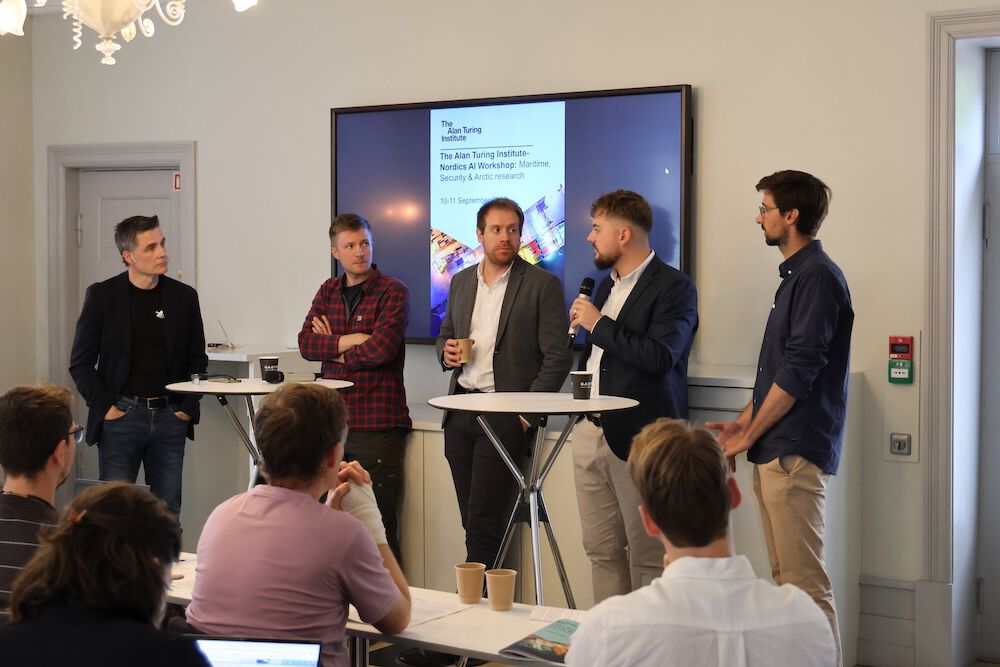
A crucial component of the first day was the funding session jointly presented by Waqar Ahmed from the Research Council of Norway and Martina Ragosta from SINTEF. This session shared practical insights into SINTEF's successful Horizon Europe applications and outlined upcoming AI-related research and innovation funding opportunities for 2026-2027. The session directly supported NAINE's (Norwegian Artificial Intelligence Network for Europe) mission to increase Norwegian participation in EU AI proposals, reflecting the workshop's practical value beyond academic exchange.
Day 2: Industry Presence and Debates
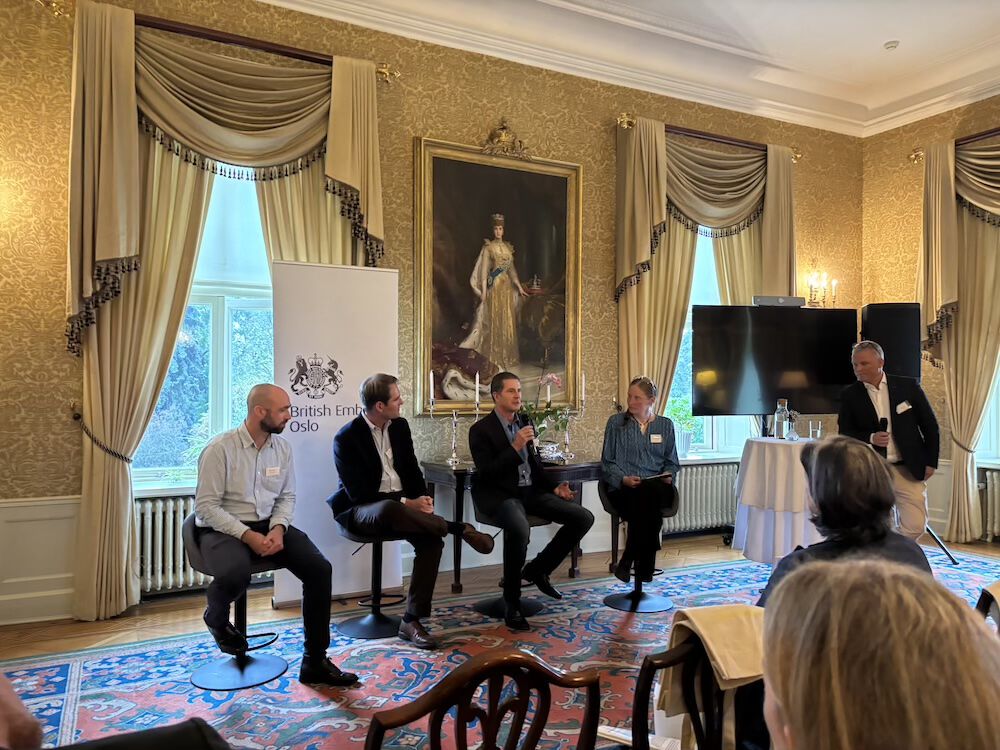
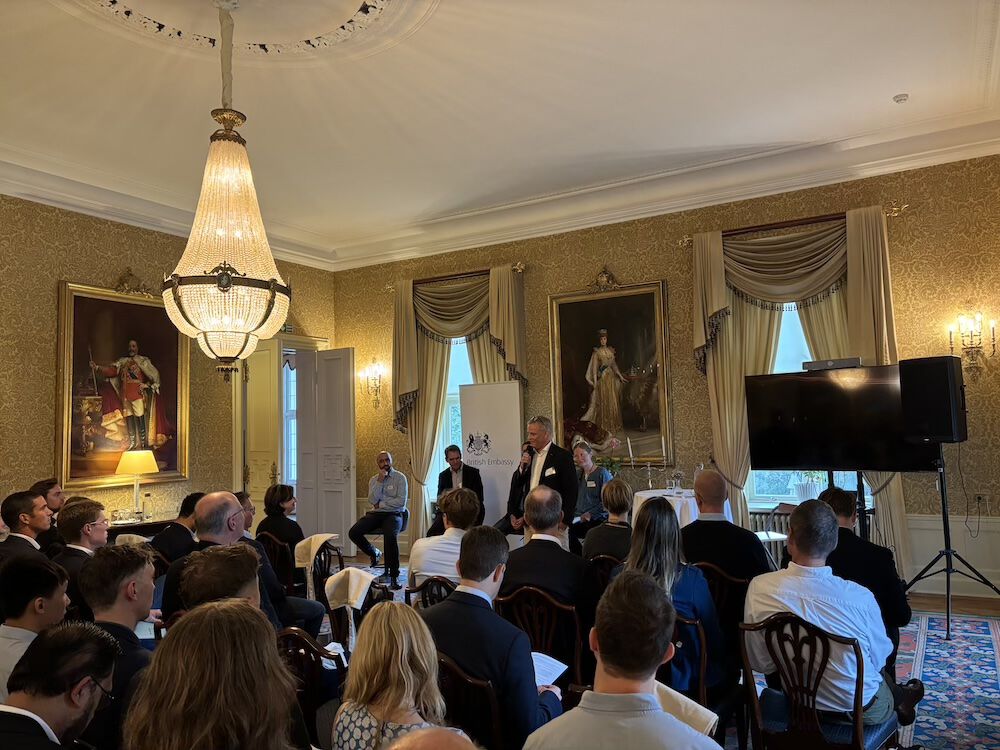
The second day, the participants gathered at the British Ambassador's Residence, where conversations focused on environmental monitoring, security applications and maritime operations. Academic researchers and industry representatives from organisations including DNV, Aker, Telenor, DigDir, Kartverket and Kongsberg - alongside innovative startups - were present.
Two roundtable discussions structured the morning: AI Applications for the North and Arctic examined shared UK-Nordic interests in offshore oil and gas, fisheries, shipping, wind energy development and security applications, addressing practical challenges.
Between Friends: What's Over-hyped in AI and What has Real Transformative Potential? offered candid assessment of current AI trends from academic and industry perspectives. Moderated by Klas Pettersen from SimulaMet, participants provided honest reflection on AI's genuine contributions versus inflated expectations, drawing on intimate knowledge of research achievements and limitations.
Strategic Importance and Future Directions
Michael Solvang, CEO of NORA, emphasized the importance of the collaboration:
- I think this workshop showed what building international AI partnerships really means. In today’s geopolitical climate, working with trusted partners around shared values is more important than in a long time. This workshop, though small, is a step in that direction.
This was NORA's second workshop with The Alan Turing Institute, and with the British Embassy and our Nordic AIR partners, the Pioneer Centre for AI (Denmark), WASP (Sweden), FCAI (Finland), and CADIA (Iceland) joining in, the event demonstrated how these relationships are maturing and creating real value. Together, they form a strong foundation for addressing shared challenges within AI research and application, especially in areas like the Arctic, security and maritime, where our expertise naturally complements each other.
Together, NORA and The Alan Turing Institute aim to strengthen UK–Norway relations and leverage the money follows cooperation agreement between the Research Council of Norway (RCN) and UK Research and Innovation (UKRI), which enables researchers in both countries to join each other’s funding calls as co-investigators. This provides a concrete pathway for long-term, cross-border collaboration.
Looking ahead, the success of this second workshop has established a valuable precedent for continued Nordic-UK collaboration. The relationships formed, research connections established and funding opportunities explored during these two days, will likely contribute to stronger research proposals, shared student supervision arrangements, and collaborative projects addressing the unique challenges of AI applications in northern environments.